

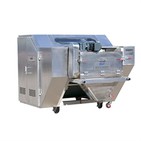

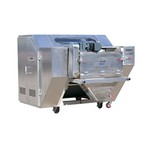
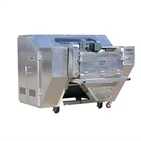
In industrial processing,efficiently cooling bulk materials is a critical step that impacts product quality,handling,and downstream operations.Among the various available technologies,the rotary drum cooler consistently proves to be a superior choice for many applications.Its advantages over other cooling methods-such as belt coolers,fluidized bed systems,or flash coolers-are rooted in a powerful combination of robust engineering,operational efficiency,and remarkable versatility.
First and foremost,the drum cooler excels in mechanical simplicity and exceptional reliability.Its core design-a rotating,slightly inclined cylinder-has few moving parts.This inherent ruggedness allows it to handle hot,abrasive,and coarse materials that would cause excessive wear or damage to more delicate systems like fluidized beds.The result is continuous,dependable operation with minimal downtime and lower long-term maintenance costs,making it a true workhorse in demanding environments.
Beyond durability,the drum cooler provides superior thermal efficiency and unmatched cooling uniformity.As the drum rotates,internal flights lift the product and cascade it in a continuous curtain through a stream of cooling air.This vigorous mixing action ensures every particle is fully exposed,eliminating hot spots and achieving a consistent,predictable discharge temperature.In contrast,linear belt coolers can suffer from thermal stratification,where material on the top cools much slower than at the bottom,leading to an uneven final product.
Unparalleled material flexibility is another key strength.A single,well-configured drum cooler can process an immense range of materials,from fine powders and granules to pellets,flakes,and nodules.This is a significant advantage over fluidized bed coolers,which are highly sensitive to particle size and density,and belt coolers,which can struggle with very fine,dusty materials.By simply adjusting the drum's rotational speed,incline,or internal flight pattern,operators can fine-tune the unit for different products,making it ideal for multi-purpose production facilities.
For high-capacity operations,the drum cooler's scalability and large-volume throughput are unmatched.It is the go-to solution for continuous,heavy-duty processing in industries like mining,fertilizers,and chemicals,where thousands of kilograms per hour are standard.Its design scales up efficiently and cost-effectively,providing reliable performance where it is needed most.Furthermore,its design facilitates effective heat recovery.The heated exhaust air can be captured and repurposed to pre-heat other process streams,improving the plant's overall energy efficiency-an option less efficiently implemented in simpler conveyor systems.
While other coolers have their place-such as fluidized beds for extremely rapid,gentle cooling of specific materials,or belt coolers for very low-temperature applications-the drum cooler's overall value proposition is compelling.It may not always be the absolute best in one specific niche,but it consistently delivers across the broadest spectrum of critical criteria:robustness,volumetric capacity,process flexibility,and operational cost-effectiveness.
In conclusion,choosing a drum cooler is often a strategic decision for long-term,reliable performance.It represents a proven,adaptable,and economical solution for safely and uniformly reducing the temperature of bulk solids,securing its status as a cornerstone of thermal processing technology worldwide.

Why Choose A Drum Cooler Over Other Cooling Methods?
Apr 25, 2026 Leave a message
Previous
How Does A Drum Cooler Work?Send Inquiry