

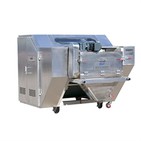

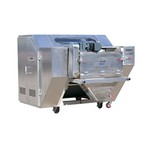
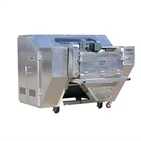
The drum cooler,also known as a rotary cooler,is a workhorse in numerous industries,including cement,mining,chemicals,and fertilizers.Its primary function is to reduce the temperature of hot materials-often discharged from a kiln,dryer,or reactor-using direct or indirect heat exchange with ambient air or other cooling media.Improving its efficiency directly translates to significant benefits:lower energy consumption,reduced operational costs,increased throughput,enhanced product quality,and a smaller environmental footprint.This article explores key areas and practical strategies to optimize the performance of a drum cooler.
1.Optimizing Heat Transfer Fundamentals
At its core,cooling is a heat transfer process.Maximizing efficiency requires enhancing the three governing principles:conduction,convection,and radiation.
•Material Bed Profile&Flight Design:The internal flights(lifters)are critical.Their design dictates how the hot material is lifted and cascaded through the cooling air stream.Optimal flight design ensures a uniform,curtain-like cascade,maximizing the exposure of particle surface area to the air.Worn or improperly designed flights lead to poor material distribution,channeling,and reduced contact time.
•Airflow Management:The cooling air must be effectively distributed.This involves:
◦Balanced Airflow:Ensuring uniform air flow across the drum's cross-section to prevent"hot spots"and bypassing.
◦Counter-Current Flow:Typically,the most efficient arrangement is counter-current flow,where the coldest air contacts the coolest product(at the discharge end)and the hottest air exits where the hot feed enters.This maximizes the temperature driving force.
◦Optimal Air Volume:The air volume must be correctly sized.Insufficient airflow limits cooling capacity,while excessive airflow wastes fan energy,can cause excessive dust carryover,and may cool the material too quickly,leading to thermal shock and product degradation(e.g.,cracking of pellets).
2.Enhancing Operational Parameters
•Rotational Speed:The drum's rotation speed controls the material residence time.Adjusting the speed to match the feed rate and required outlet temperature is vital.Variable Speed Drives(VSDs)allow for precise control,adapting to process fluctuations and saving energy during low-load conditions.
•Drum Inclination:Along with speed,the drum's angle of inclination governs residence time.A steeper angle reduces residence time,which may be suitable for less demanding cooling,while a shallower angle increases it for more thorough cooling.
•Material Feed Rate and Temperature:Consistent,controlled feeding of the hot material is essential.Wide fluctuations in feed rate or inlet temperature make it difficult to maintain stable,efficient cooling conditions.Pre-conditioning or feed homogenization can significantly improve downstream cooler stability.
3.Equipment and Maintenance Optimization
•Sealing Systems:Effective seals at the inlet and outlet of the drum are crucial to prevent air infiltration or leakage.Uncontrolled false air ingress disrupts the designed airflow pattern,reduces cooling efficiency,and increases fan load.Regular inspection and maintenance of seal integrity are low-cost,high-impact activities.
•Refractory Lining:For very high-temperature applications,a well-maintained refractory lining on the shell protects the steel structure and minimizes radial heat loss to the environment,ensuring heat is removed primarily by the cooling air.
•Drive and Bearing Efficiency:Ensuring the mechanical integrity of the drive train(gears,pinions)and support bearings(trunnion rollers)reduces parasitic power losses.Proper alignment and lubrication are fundamental.
•Dust Control:Integrated dust collection systems(baghouses,ESPs)are necessary.However,their pressure drop contributes to the system's total airflow resistance.Optimizing filter cleaning cycles and maintaining the system minimizes the additional fan power required.
4.Advanced Control and Heat Recovery
•Automated Control Systems:Implementing a advanced process control(APC)system that uses real-time data(outlet temperature,airflow,motor load)to automatically adjust rotation speed,fan speed,and other variables can maintain peak efficiency continuously,far outperforming manual operation.
•Waste Heat Recovery:The hot exhaust air from the cooler often contains significant low-to-medium grade heat.This energy can be recovered for:
◦Combustion Air Pre-heating:Directing hot exhaust to the kiln or furnace as secondary combustion air.
◦Feed Material Pre-heating:Using the heat to warm incoming raw materials or moisture removal.
◦Steam Generation:Via a waste heat recovery boiler(WHRB)for power generation or process steam.
◦Space Heating:For nearby facilities.
5.Emerging Technologies and Retrofits
•Computational Fluid Dynamics(CFD)Modeling:CFD can be used to simulate the complex multiphase flows inside the cooler.It is a powerful tool for diagnosing problems,testing new flight designs virtually,and optimizing airflow patterns before implementing physical changes.
•High-Efficiency Fans&Motors:Retrofitting old fans with aerodynamically efficient designs and replacing standard motors with high-efficiency IE3/IE4 class models can yield substantial electrical savings.
•Thermal Imaging:Periodic or continuous thermal imaging of the drum shell can identify localized hot spots indicating refractory failure,material buildup,or uneven cooling.
Improving drum cooler efficiency is not a single action but a holistic approach combining sound fundamentals,precise operation,diligent maintenance,and strategic upgrades.The most significant gains often come from addressing basics:ensuring optimal airflow distribution,maintaining proper flight action,and securing effective sealing.From this foundation,investments in advanced control systems and waste heat recovery deliver the next level of performance,turning the drum cooler from a simple cooling device into an integral part of an energy-efficient and sustainable production circuit.A systematic audit focusing on these areas will invariably reveal opportunities for meaningful optimization and cost savings.

How To Improve The Efficiency Of A Drum Cooler?
Apr 27, 2026 Leave a message
Previous
No InformationSend Inquiry