

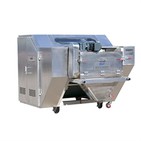

A drum cooler,also known as a rotary drum cooler,is commonly used in industries such as cement production,mining,and chemical processing to reduce the temperature of hot materials.Its main components include:
1.Rotating Drum–A large,cylindrical shell that rotates slowly,providing a surface for hot materials to cool through direct or indirect heat exchange.
2.Drive System–Comprising a motor,gearbox,and sometimes chains or belts to rotate the drum at a controlled speed.
3.Support Structure–Includes trunnion wheels,bearings,and a base frame to support and stabilize the drum during rotation.
4.Inlet and Outlet–The inlet feeds hot materials into the drum,while the outlet discharges cooled materials.
5.Heat Exchange System–Can involve internal lifters or flights that lift and cascade materials for better air contact,or external cooling media like water or air flowing around the drum.
6.Cooling Medium Supply–Fans or water circulation systems that introduce air or water to absorb heat from the materials.
7.Sealing Units–Seals at the inlet and outlet to prevent air leakage and maintain cooling efficiency.
8.Exhaust System–Removes hot air or gases generated during the cooling process.
These components work together to ensure efficient and uniform cooling of bulk materials,often as part of a larger production line.
The Rise of Renewable Energy:A Sustainable Future
In recent decades,the global demand for energy has surged,driven by population growth,industrialization,and technological advancement.However,reliance on fossil fuels has led to environmental degradation,climate change,and geopolitical tensions.In response,renewable energy has emerged as a vital solution for a sustainable future.
Renewable energy derives from natural sources that are constantly renewed,such as sunlight,wind,water,and geothermal heat.Unlike fossil fuels,these sources produce little to no greenhouse gas emissions,reducing the carbon footprint.Solar power,for instance,harnesses energy from the sun through photovoltaic panels,while wind turbines convert kinetic energy from wind into electricity.Both have seen dramatic cost reductions and efficiency improvements,making them increasingly competitive with traditional energy sources.
Hydropower remains one of the oldest and most established renewable sources,providing large amounts of electricity through dams and flowing water.Geothermal energy,though less widespread,taps into the Earth's internal heat for power generation and heating.Additionally,biofuels and ocean energy represent emerging alternatives with significant potential.
The transition to renewable energy is not without challenges.Intermittency-such as when the sun doesn't shine or the wind doesn't blow-requires advancements in energy storage,like batteries,and smart grid technology.Moreover,initial investment costs and infrastructure upgrades can be barriers,particularly in developing regions.
Nevertheless,governments and private sectors worldwide are increasingly investing in renewables.Policies such as subsidies,carbon pricing,and international agreements like the Paris Accord are accelerating adoption.Beyond environmental benefits,this shift promises energy independence,job creation,and improved public health.
In conclusion,renewable energy is more than an alternative-it is a necessity for a sustainable planet.Through innovation and collaboration,a future powered by clean,abundant energy is within reach,ensuring both ecological balance and economic resilience for generations to come.

What Are The Main Components Of A Drum Cooler?
Apr 25, 2026 Leave a message
Send Inquiry