

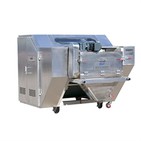

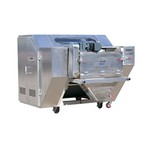
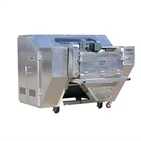
A drum cooler,also known as a rotary cooler or drum flaker,is an industrial heat exchanger designed to cool or solidify liquid,slurry,or paste-like materials by transferring heat from the product to a cooling medium.It is widely used in chemical processing,food production,plastics manufacturing,and waste treatment.The drum cooler operates on a relatively simple yet efficient principle involving conduction,convection,and sometimes evaporation.Here's a step-by-step explanation of its operation.
1.Basic Structure
A typical drum cooler consists of:
•Rotating Drum:A large,hollow metal cylinder(made of stainless steel or other conductive materials)that rotates slowly around its horizontal axis.
•Cooling Medium:Water or refrigerant circulated inside the drum.
•Feed System:A trough,spray nozzle,or applicator to deliver the hot liquid onto the drum's outer surface.
•Scraper Blade:A knife positioned against the drum surface to remove the cooled solid product.
•Drive System:Motor and gears to rotate the drum at a controlled speed.
2.Working Principle
Step 1:Application of Hot Material
The hot liquid or slurry is fed onto the outer surface of the rotating drum.This can be done via a thin film applicator,a dip-feed system(where the drum dips into a feed tank),or spraying.The goal is to form a uniform thin layer(typically 0.5–2 mm)on the drum surface.
Step 2:Cooling and Solidification
Inside the hollow drum,a cooling medium(usually chilled water or brine)is circulated.As the drum rotates,the hot material on the outside loses heat through the metal wall to the coolant inside.The rapid heat transfer causes the material to cool and,in many cases,solidify into a brittle film or flakes.The drum's rotation speed is adjusted to allow sufficient contact time for the desired cooling effect.
Step 3:Product Removal
Once the drum rotates to a certain point,the solidified layer meets a scraper blade(doctor blade)mounted close to the drum surface.The blade gently peels off the cooled product in the form of flakes,chips,or a continuous sheet.
Step 4:Cooling Medium Recirculation
The coolant inside the drum absorbs heat from the product and exits at a higher temperature.It is then recirculated through an external chiller or cooling tower to reject the absorbed heat and return to the desired low temperature.
3.Heat Transfer Mechanism
The primary mode of heat transfer is conduction through the drum wall.The thin product layer maximizes the surface area for rapid cooling.Additional cooling may occur via convection(if ambient air flows over the product)or evaporation(if the product contains volatile components that vaporize).
Some designs use a double-drum configuration,where two parallel drums rotate toward each other,with the feed introduced into the gap between them.This increases throughput and allows cooling from both sides.
4.Applications
•Chemical Industry:Solidifying fatty acids,resins,sulfur,or waxes.
•Food Processing:Cooling chocolate,margarine,or producing flaked food products.
•Environmental Engineering:Solidifying sludge or waste liquids for easier handling.
•Pharmaceuticals:Cooling and forming heat-sensitive pastes or gels.
5.Advantages
•Continuous Operation:Suitable for high-volume production.
•Compact Design:Large surface area in a relatively small footprint.
•Controlled Cooling Rate:Adjustable drum speed and coolant temperature allow precise product quality control.
•Good Heat Transfer Efficiency:Thin product layers enable rapid,uniform cooling.
6.Limitations
•Not ideal for highly viscous or sticky materials that are hard to remove.
•Regular maintenance is needed for the scraper blade and drum surface.
•Initial setup and cooling system can be energy-intensive.
A drum cooler works by spreading a thin layer of hot material onto a rotating,internally cooled metal drum.Heat is quickly conducted away,solidifying or cooling the product,which is then scraped off for collection.Its efficiency,simplicity,and adaptability make it a valuable tool in many industries requiring rapid thermal processing of liquids or pastes.

How Does A Drum Cooler Work?
Apr 25, 2026 Leave a message
Send Inquiry